Watch_Dogs 2 finally makes the hacking feel like yours
The first Watch_Dogs had a hacking system that felt like a vending machine: insert correct button press, receive scripted explosion. Aiden Pearce would stand still, the camera would swoop dramatically, and a pipe would burst or a car would swerve. It looked impressive the first time and mechanical every time after. Nobody played that game and felt clever. They felt like they were watching someone else be clever.
Watch_Dogs 2 fixes that problem in a way that Ubisoft’s marketing never quite articulated. Marcus Holloway’s San Francisco isn’t just a prettier backdrop — it’s a playground designed around the assumption that players will experiment. The hacking tools actually talk to each other. And once you start pulling on that thread, the whole game changes shape.
The two-gadget trick that unlocks everything
Marcus carries two deployable gadgets: the Jumper, a small RC car, and the Quadcopter drone. On paper they sound like extra inventory. In practice they’re the entire game. The drone can hack environmental systems from the air without triggering alerts. The Jumper can crawl through vents and reach server rooms Marcus himself can never reach. Used together, you can clear a heavily guarded compound without Marcus ever leaving cover.
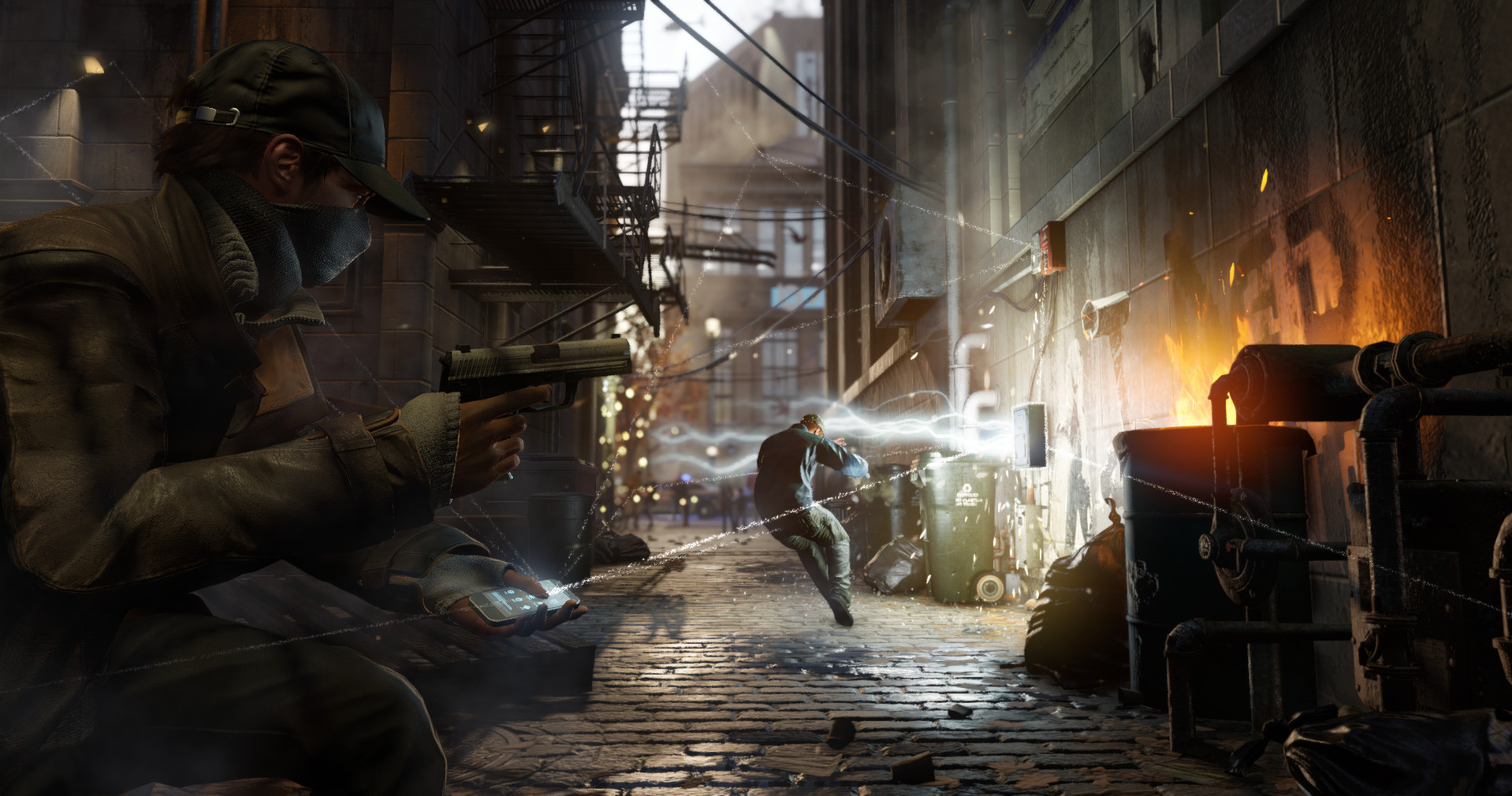 Scene from Watch_Dogs 2.
This matters because it turns every restricted area into a puzzle box rather than a combat gauntlet. Ubisoft Montreal designed enough vertical geometry and ventilation access across the environments that there’s rarely only one route. Sometimes you’ll spot a scissor lift you can activate remotely to get a security camera’s blind spot. Sometimes the drone can hack a guard’s phone and distract them long enough for the Jumper to move. It creates a loop that never quite repeats the same way twice.
The skill tree reinforces this flexibility without forcing a single archetype. Stealth hacking, aggressive hacking, and environmental manipulation all sit on the same tree and unlock gradually, so a playthrough that leans heavily into non-lethal takedowns doesn’t feel like it’s playing a hobbled version of the game. That’s a design choice that seems small until you remember how many open-world games funnel you toward a dominant strategy by mid-game.
Combat is the rough edge, and it stays rough
Here’s the honest part: the gunplay is bad. Not Deadly Premonition bad, but noticeably floaty and without satisfying feedback. The weapons don’t feel like they have mass. Enemies absorb shots in ways that feel inconsistent with their apparent armor. If Watch_Dogs 2 were a third-person shooter first and a hacking game second, this would be disqualifying.
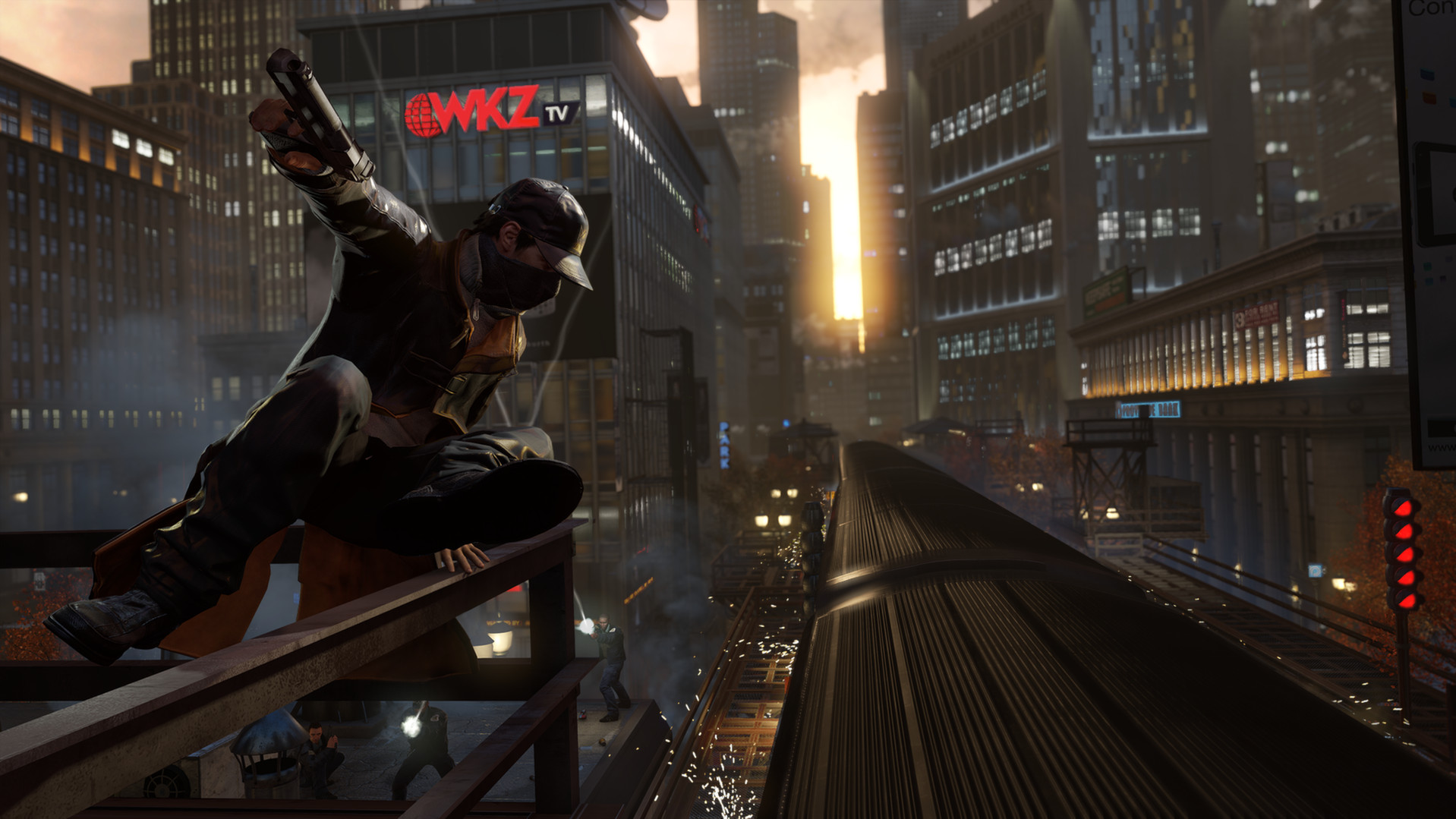 Scene from Watch_Dogs 2.
The game seems to know this. Direct combat is mechanically possible but the design actively discourages it. Police aggression escalates faster than in most open-world games, reinforcements arrive sooner, and Marcus’s own health pool is fairly unforgiving on default difficulty. The nudge is clear: use the tools you were given. Players who resist that nudge and try to run Watch_Dogs 2 as a cover shooter will have a worse time than they would playing almost any actual cover shooter from the same era.
There’s a version of this critique that says Ubisoft should have built better gunplay anyway, and that version isn’t wrong. But the combat weakness does have a strange effect: it reinforces the fantasy. You’re not meant to be Aiden Pearce with a shotgun. You’re meant to be a hacker who, when cornered, is genuinely scrambling. Getting shot feels like a mistake rather than a damage calculation. That doesn’t make the shooting good. It makes it contextually defensible.
San Francisco as a design document
The city is built for the tools. That sounds obvious, but compare it to how Watch_Dogs 1’s Chicago felt — mostly flat, mostly wide, mostly about cars. San Francisco’s verticality, its dense neighborhoods, its bridges and hills and the contrast between tech campuses and residential streets, all of it creates natural scenarios. A late-game infiltration of a corporate campus uses the open-plan architecture against security patrols in ways that feel like Ubisoft Montreal actually walked those kinds of offices before building them.
The ctOS systems woven through the environment — traffic lights, security cameras, construction cranes, forklifts — are dense enough that you rarely enter a restricted zone without options. That density does occasionally tip into noise. There were moments, especially in tighter interiors, where I triggered things I didn’t mean to trigger because the interaction prompts overlapped. The Jumper in particular can lose its camera angle in cluttered spaces and become briefly useless. These are friction points, not fatal flaws.
DedSec and the question of whether the story earns its politics
The narrative is genuinely trying to say something about surveillance capitalism, algorithmic profiling, and tech-bro culture circa 2016. Some of it lands. The framing of corporations using predictive algorithms to flag people as future criminals — which is how Marcus ended up in the system — is handled with more specificity than you’d expect from a mid-budget Ubisoft open-world. The early game has real anger in it.
The DedSec crew itself is hit and miss. Sitara is sharp and consistent. Wrench is the kind of loud chaotic character who works better in smaller doses than the game gives him. Josh gets underdeveloped. The tone shifts into self-parody more than once, and there are missions built around satirizing cult-like self-help companies or fictional social media platforms that feel like they’re punching at obvious targets to avoid harder ones. The game is better at systemic critique than character-driven critique.
What sticks is Marcus himself. He’s more grounded than the plot sometimes deserves, and his reaction animations — small gestures during cutscenes, the way he moves through the world — give him a physicality that Aiden Pearce never had. Ubisoft clearly invested in the protagonist even when the surrounding cast wavered.
The missions that actually linger
A few missions are genuinely memorable in the way that good immersive-sim levels are memorable: you talk about how you did them. One mid-game operation involving a film studio and multiple layered security zones is a legitimate design showcase. The ctOS systems, the gadgets, the environment, and the optional stealth approach all align in a way that makes the moment feel authored without being on rails. It’s the kind of thing Deus Ex fans describe when they explain what they love about that series — that sense that the designers set up a space and trusted you to find your own way through it.
Not every mission reaches that level. Some are straightforward chase sequences or protection missions that the game’s mediocre driving and shooting can’t really support. The side content is uneven — some of it adds texture, some is checklist filler dressed up with DedSec branding. The pacing goes soft in the middle third, when the game loses urgency before the back half recovers it.
What this game actually is
Watch_Dogs 2 is the rare sequel that identified precisely what was wrong with its predecessor and corrected it at the design level rather than the surface level. It’s not a great shooter. It’s not a great driver. The story has ambitions it doesn’t fully meet. But as a hacking sandbox — as a game about feeling capable through tools rather than through stats — it’s one of the better examples in the open-world genre. Ubisoft doesn’t make games like this anymore, which is either a market reality or a loss depending on how much you valued what this one was doing.
If you bounced off the first game, or if you assumed this was more of the same with a sunnier aesthetic, the actual experience is worth revisiting. Set the difficulty up a notch, lean into the gadgets, and resist the urge to treat every restricted zone like a firefight waiting to happen. The game opens up in a way that earns the phrase ’the hacking feels like yours’ — because by the end, the approach you’ve built genuinely is.
Editorial scoring
Reader Q&A
How long does it take to finish Watch_Dogs 2 finally makes the hacking feel like yours?
Main story runs around 47 hours depending on how thoroughly you explore. Completionists can spend 2-3× that.
Is Watch_Dogs 2 finally makes the hacking feel like yours good for newcomers to Open-World Hacking?
Yes — Watch_Dogs 2 finally makes the hacking feel like yours is a great entry point. The early hours teach the systems gradually and the difficulty curve is reasonable.
Which platform should I play Watch_Dogs 2 finally makes the hacking feel like yours on?
PC version offers the highest fidelity if your rig can handle it. Console versions are polished out of the box.
Was Watch_Dogs 2 finally makes the hacking feel like yours worth the launch-day price?
Depends on backlog. The replay value justifies the price for genre fans; casual players should wait for a 40%+ discount.
Are there DLCs or expansions worth picking up?
Skip the cosmetic DLC. The story expansion is the only one we’d recommend at full price.
What did Ubisoft Montreal get right (and what could be better)?
The systems are confident and the combat is satisfying. The story handoffs and load times are the rough spots.