Hollow Knight earns every inch of its darkness
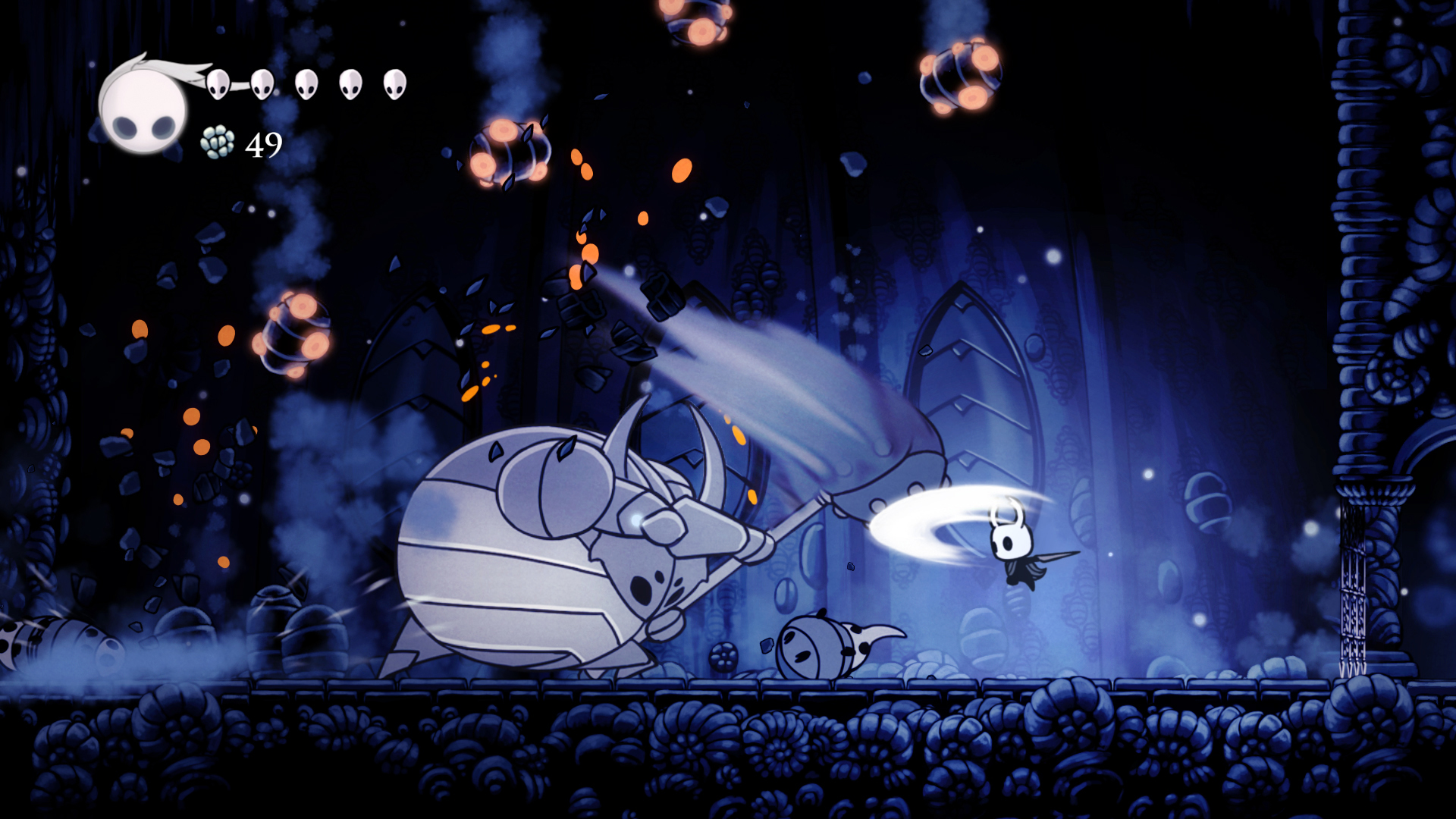
There is a moment early in Hollow Knight where you drop into a new chamber, the ambient hum shifts register, and a creature you’ve never seen attacks from a direction you didn’t expect. You die. You respawn at the last bench you rested on, retrace your steps, collect your lost geo from the shade you left behind, and try again. The whole cycle takes maybe four minutes. What’s striking is that none of it feels punitive — it feels like the game teaching you its grammar in the only language it knows.
Team Cherry’s 2017 Metroidvania has accumulated a reputation so large that engaging with it critically almost requires clearing that reputation out of the way first. The praise is, by now, reflex: ’beautiful’, ’challenging’, ’atmospheric’. Those words are not wrong, but they don’t explain why a first-time player will still be thinking about the Mantis Lords fight a week after it happens, or why the map system — which seems annoying in the first hour — turns into one of the most satisfying progression tools in the genre. So let’s look at the actual parts.
What the movement actually does
The Knight moves with deliberate weight. There’s a short hang at the apex of a jump, nail strikes have a slight recovery window, and the dash has no invincibility frames by default. Each of these is a quiet constraint that shapes how you read a room. You can’t spam your way through encounters the way you can in, say, Ori and the Blind Forest, where movement is so fluid it occasionally removes the need for spatial thinking. Here, you need to account for your own hitbox as much as an enemy’s.
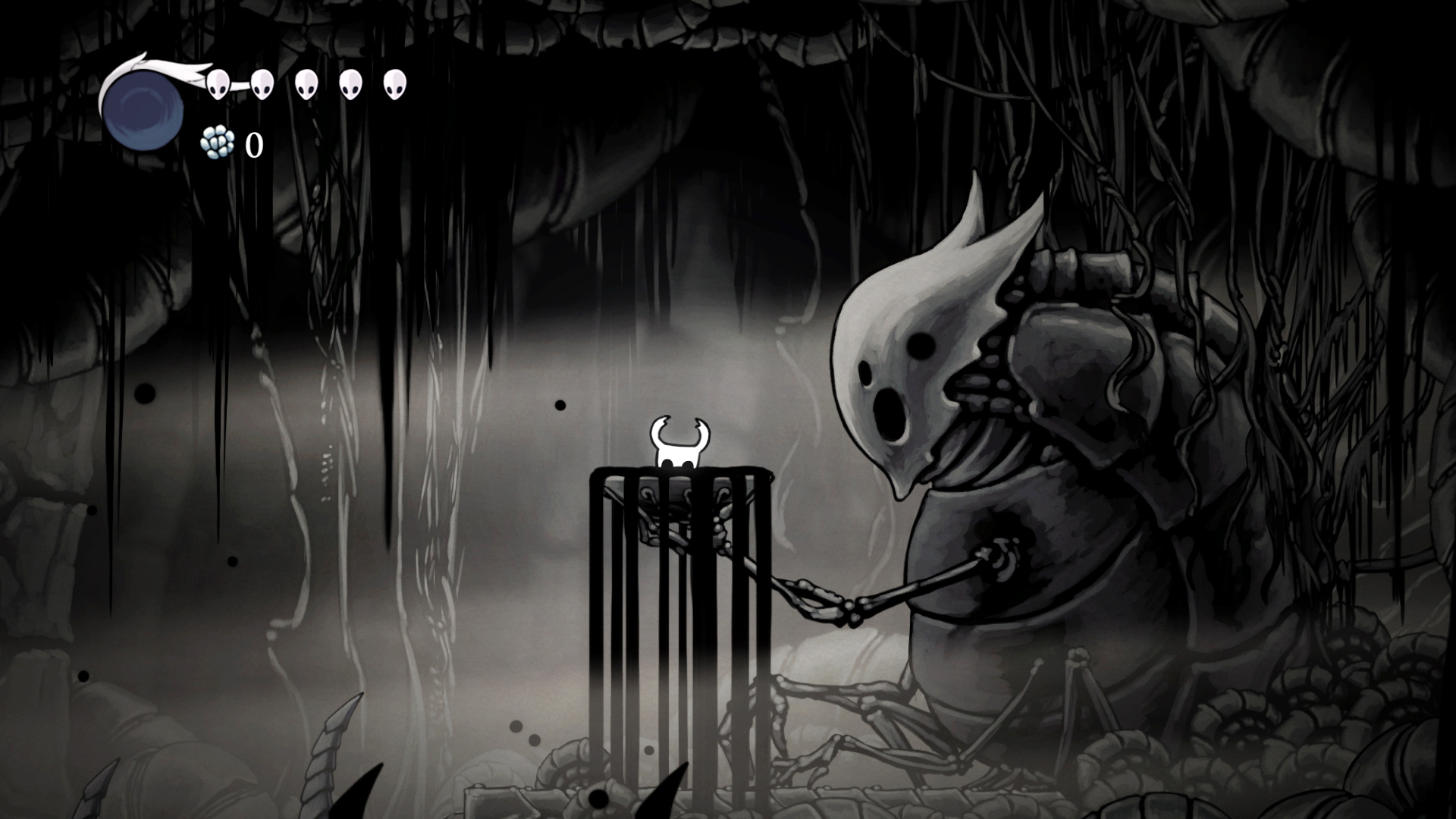 Atmospheric detail in Hollow Knight.
The pogo mechanic — bouncing off enemies and projectiles with a downward nail strike — is introduced through environmental design rather than a tutorial popup. Certain vertical shafts make no sense without it. Certain bosses become manageable once you start using it offensively. Team Cherry never announces this. They just build rooms where the answer is there if you look at the geometry. It’s the same discipline you see in FromSoftware’s level design, where spatial information is instruction in disguise.
The Mothwing Cloak and Mantis Claw arrive at roughly the pace you’d expect from a genre with thirty years of precedent, but they don’t feel like formula — partly because the map you’re traversing is genuinely strange, and partly because each new ability recontextualizes previous areas without requiring overt backtracking prompts. The game doesn’t flash icons on the map saying ’you can reach this now.’ You remember places because the world is coherent enough to remember.
The Charm system is messier than people admit
Hollow Knight’s loadout customization runs through Charms: equippable trinkets that cost Notch slots and modify combat, mobility, or Soul generation in meaningful ways. Fragile Strength bumps nail damage significantly. Quick Slash increases attack speed at the cost of individual hit power. Joni’s Blessing converts your normal health masks into a single larger pool. On paper, this sounds like a flexible build system. In practice, it’s a little lopsided.
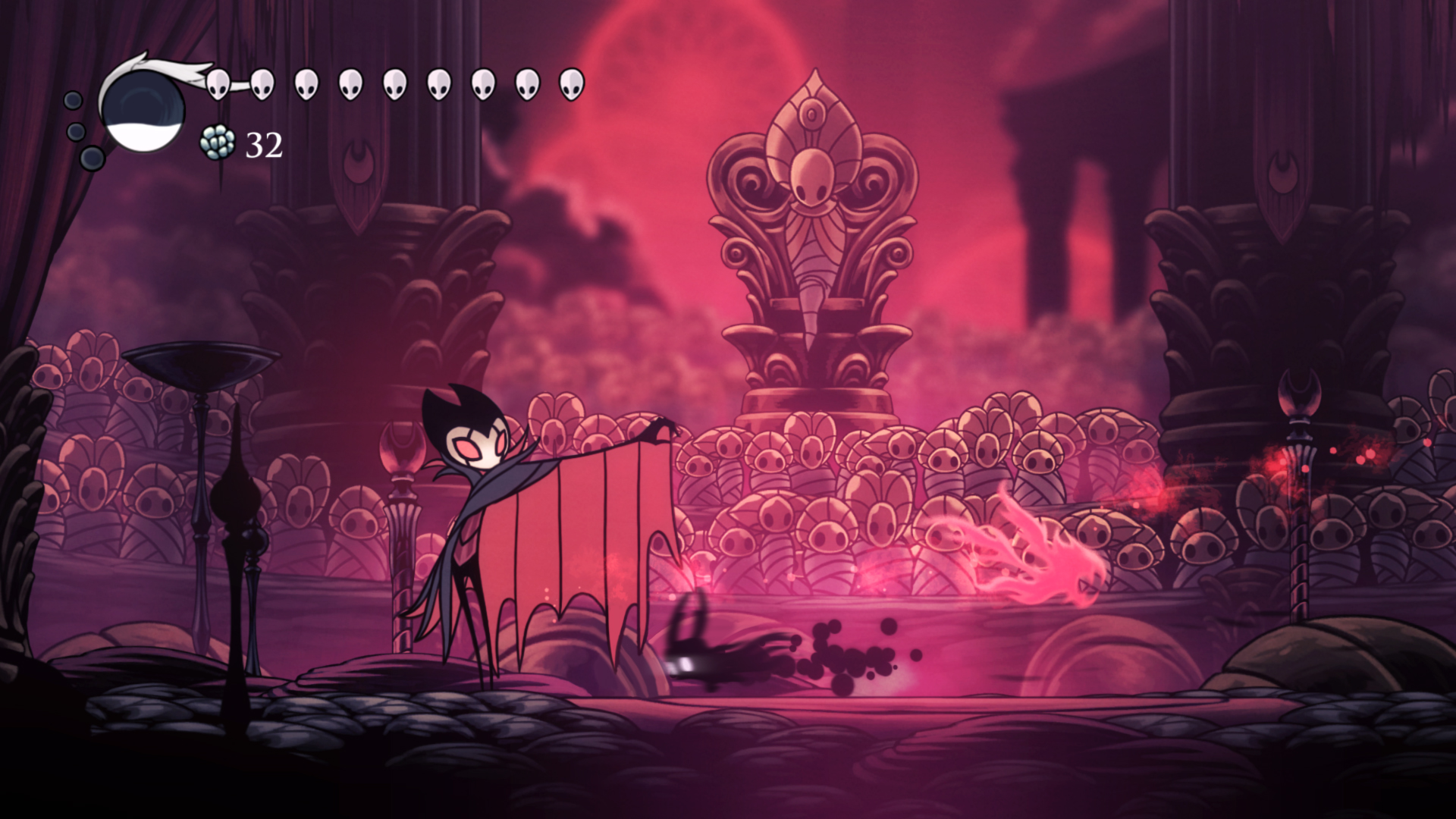 Combat encounter in Hollow Knight.
Many runs converge on a handful of damage-amplifying combinations because the game’s mid-to-late sections reward aggressive pressure far more than defensive play. The Grubsong and Fragile Heart charms — the survival-oriented options — rarely feel as immediately effective as stacking offensive output. Players who discover Shaman Stone and Spell Twister early enough will often centre their whole playstyle around Soul-based spells, which is legitimate but narrow. The build diversity the system implies is real at the margins; it’s just less pronounced than the charm count suggests.
That said, the Charm system does something genuinely useful for players who bounce off difficult games: it externalizes the difficulty dial without calling it that. Equipping more health-sustaining charms before a boss you’re struggling with is not a separate ’easy mode’ menu — it’s a diegetic choice that the game frames as strategy. Supergiant did something similar with the boon system in Hades, though Hades makes the tuning far more granular and immediate. Hollow Knight’s version is cruder but less obtrusive.
The map and the bench are doing a lot of quiet work
Cornifer, the cartographer you find huddled in various zones, sells you partial maps of each area. The maps only update when you sit at a bench. This combination — incomplete information, deferred update — sounds like friction for friction’s sake. In the first two hours, it kind of is. But it creates a rhythm: explore until you’re uncertain, rest and update your knowledge, plan the next push. The bench becomes a meaningful pause rather than a cosmetic checkpoint.
This also means your mental model of the world stays active. Because the map doesn’t fill itself in automatically, you’re constructing a rough spatial understanding of each zone between updates. You learn to recognize visual landmarks — the colour of a background, the texture of a ceiling — in ways that most genre peers don’t demand. It’s uncomfortable to notice how much more passive the experience feels in a game like Guacamelee, where the map is always comprehensive and exact.
The lore keeps its distance, and that’s the right call
Hallownest’s history is delivered through inscriptions, dream sequences, vendor dialogue, and enemy designs rather than cutscenes. The Pale King, the Infection, the relationship between the Knight and the Hollow Knight — none of it is spelled out. Players who want the full picture need to read item descriptions, seek out optional dreamers, and cross-reference things that the game never explicitly connects. Some find this obscurantist. It’s actually a considered structural decision.
The emotional texture of the world lands harder because you piece it together. The White Lady’s dialogue hits differently once you understand what she gave up. The Grimm Troupe content — an event questline available after a trigger mid-game — works partly because it arrives in an established world you’ve already partially decoded, so its strange theatrical energy feels like disruption rather than decoration. Team Cherry trusted players to synthesise information, which is rarer than it should be.
The one area where this restraint falters is in the final stretch, where the lore density spikes sharply and several story beats require outside research to fully parse. The game has always been cryptic, but certain revelations feel less earned than withheld. It’s a tension the genre frequently fails to resolve cleanly, and Hollow Knight doesn’t fully escape it.
Boss design as the clearest expression of the game’s values
The Mantis Lords fight is the clearest example of what Hollow Knight is actually trying to do. Three enemies, a symmetrical arena, attack patterns that are readable on the third attempt and almost elegant by the tenth. The fight has no cheap mechanics. It doesn’t speed up arbitrarily. It asks you to internalize a rhythm and execute it under pressure. When you clear it, the Lords bow — and the gesture means something because you’ve met the game’s terms, not negotiated a workaround.
Not every boss reaches this clarity. Some later encounters introduce awkward hitboxes or arena conditions that feel like difficulty amplified through inconvenience rather than design. The Watcher Knights, fought in sequence, veer close to this — adding numbers where the Mantis Lords added choreography. But these are exceptions. The majority of the encounter roster is tightly designed, and the pattern recognition they demand is exactly the skill the movement and charm systems have been building since the start of the game.
Who this game is actually for
Hollow Knight is not for players who want their curiosity rewarded quickly. The opening hours are genuinely slow, the initial weapon feels limited, and the world withholds directions. Players coming from something like Ori and the Will of the Wisps, which delivers spectacle continuously and navigational clarity immediately, will find the pacing alien. That’s not a flaw — it’s a different contract.
The players who tend to stay are those who find the fog of exploration motivating rather than stressful, and who are willing to carry a mental model of a space rather than outsource it to a minimap. That’s a smaller audience than the game’s reputation implies, and the reviews that treat it as universally accessible do some disservice to the people who might bounce off it and blame themselves.
What holds up, seven years after release, is the consistency of the creative logic. Almost every system — movement weight, charm customization, map gating, lore delivery, boss choreography — is pointing in the same direction. The game knows what it is and does not hedge. That kind of coherence is hard to manufacture and impossible to fake, which is why Hollow Knight still functions as the standard against which smaller Metroidvanias are measured, fairly or not.
Editorial scoring
Reader Q&A
How long does it take to finish Hollow Knight earns every inch of its darkness?
Main story runs around 85 hours depending on how thoroughly you explore. Completionists can spend 2-3× that.
Is Hollow Knight earns every inch of its darkness good for newcomers to Metroidvania?
It depends. The systems are deep but the tutorial does a fair job. Veterans of Metroidvania will feel at home faster.
Which platform should I play Hollow Knight earns every inch of its darkness on?
Steam Deck handles this title well — verified compatibility on most recent patches.
Was Hollow Knight earns every inch of its darkness worth the launch-day price?
If you’re a fan of Team Cherry, yes. If you’re new to the studio, a sale price is more comfortable.
Are there DLCs or expansions worth picking up?
The base game is complete; expansion DLC adds 10-15 hours of additional content if you want more.
What did Team Cherry get right (and what could be better)?
Strongest: art direction, audio design, set-piece variety. Weakest: late-game balance and a few persistent quest-log bugs.