Helldivers 2 is at its best when everything goes wrong
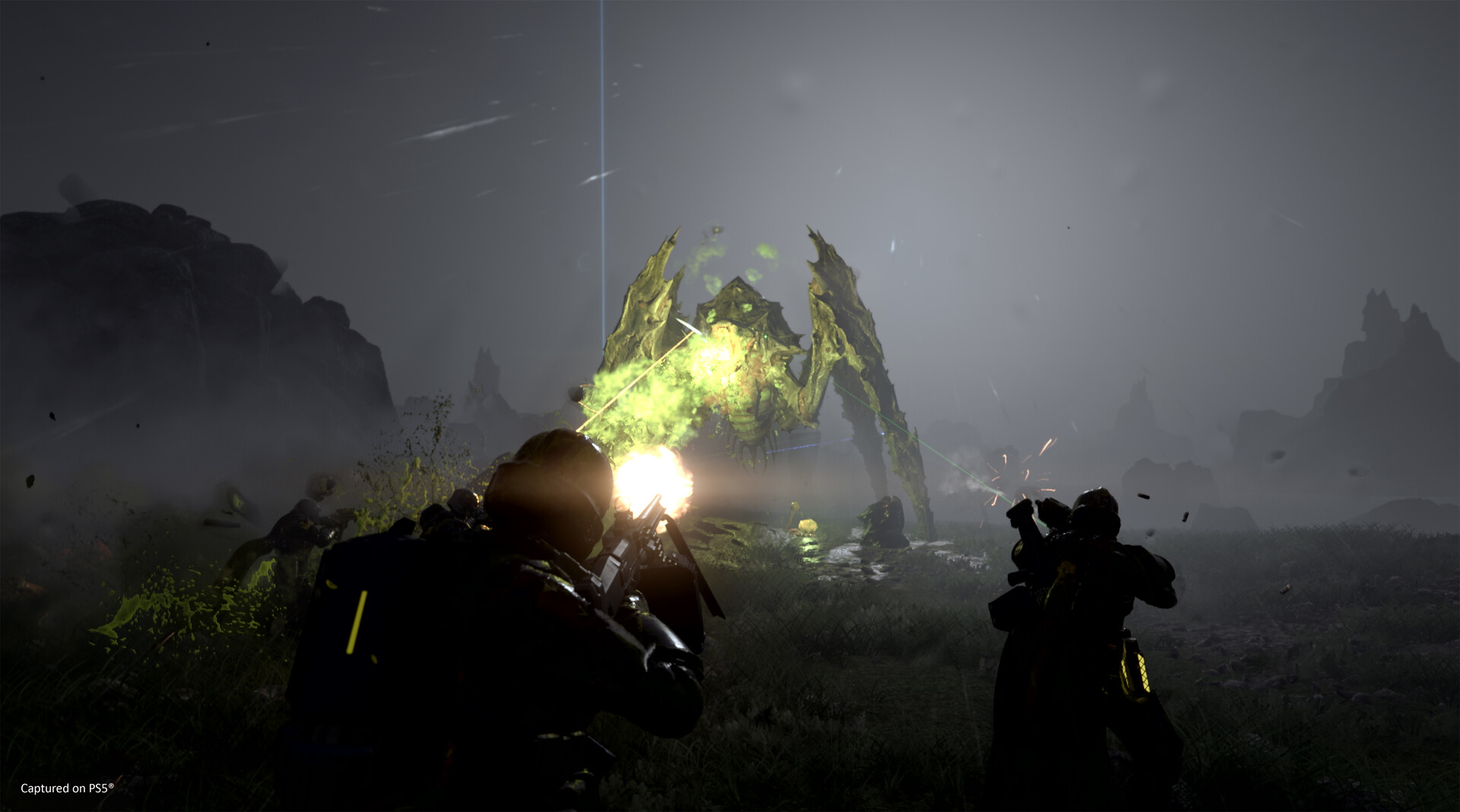
Helldivers 2 launched in February 2024 and promptly broke PlayStation Network login servers under the weight of people trying to play it. That’s as good a symbol as any for what Arrowhead Game Studios built: something messier and more alive than anyone expected, attracting an audience large enough to expose every seam in the infrastructure holding it together. The game itself operates on roughly the same principle.
On paper, it’s a third-person cooperative shooter where squads of four drop onto hostile planets, complete objectives, and extract before dying too many times. In practice, it’s a machine for generating disasters — and the disasters are the point. Whether that proposition appeals to you will probably determine whether this ends up installed for six months or uninstalled after a weekend.
The loop is tighter than it looks
Each mission drops you onto a planet with a timer, a handful of objectives, and a loadout you selected before you had any real idea what you’d be facing. That pre-mission commitment matters more than most shooters allow. You can’t swap your Stratagem assignments mid-drop — the orbital bombardment support, the turrets, the resupply beacons — so every mission starts with a small exercise in planning under incomplete information. Get it wrong and you spend twenty minutes compensating. Get it right and you feel unreasonably clever.
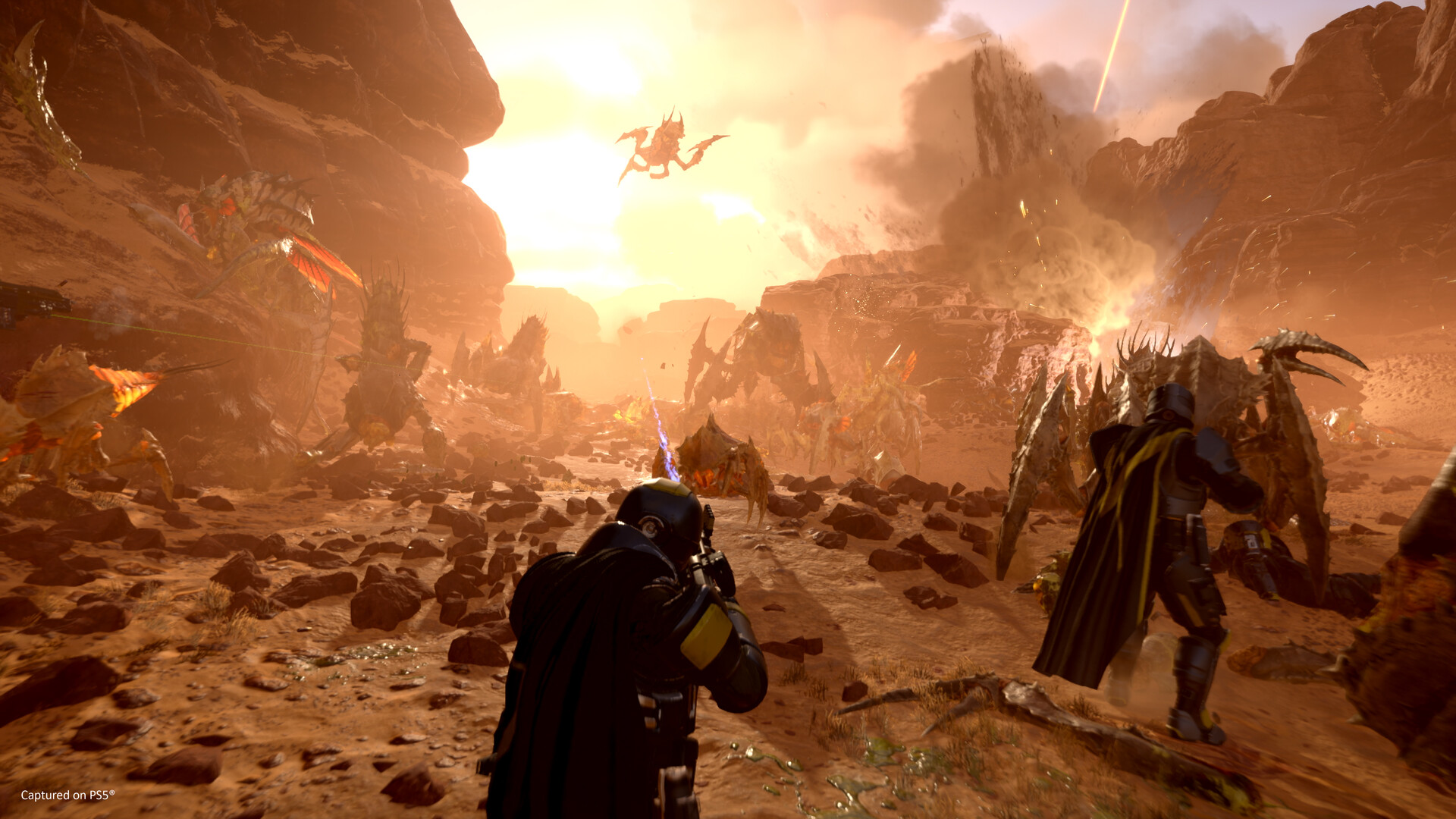 Atmospheric detail in Helldivers 2.
The Stratagems themselves are the mechanical centrepiece. Calling in an Eagle airstrike requires punching in a directional input sequence, which sounds absurd until you’re doing it while sprinting from a Charger — a hulking Terminid enemy — and managing to land the call accurately enough to vaporize the threat without killing your teammates. The input requirement is deliberate friction. It creates a specific kind of pressure that mouse-click confirmation would completely dissolve. Arrowhead clearly understood that convenience isn’t always a virtue.
When the plan falls apart
The first time a mission collapses — and it will — you learn something the game never explicitly tells you. Failure isn’t a wall. It’s a state you operate in. You run low on reinforcement tickets, someone’s Stratagem is on a long cooldown, the extraction zone is swarming, and yet the mission remains completable. That compression of resources forces improvisation in a way that most cooperative games avoid, because most games treat player frustration as an enemy to be managed rather than a texture to be designed around.
Compare that to something like Deep Rock Galactic — a game Helldivers 2 gets compared to constantly, sometimes unfairly — where Ghost Ship Games built its difficulty around escalating wave density but kept the team’s toolkit generous enough that genuine catastrophe is rare. Helldivers 2 is more willing to watch you suffer. That’s not a complaint, exactly. It’s a design philosophy that makes extraction feel earned in a way that a smoother game wouldn’t.
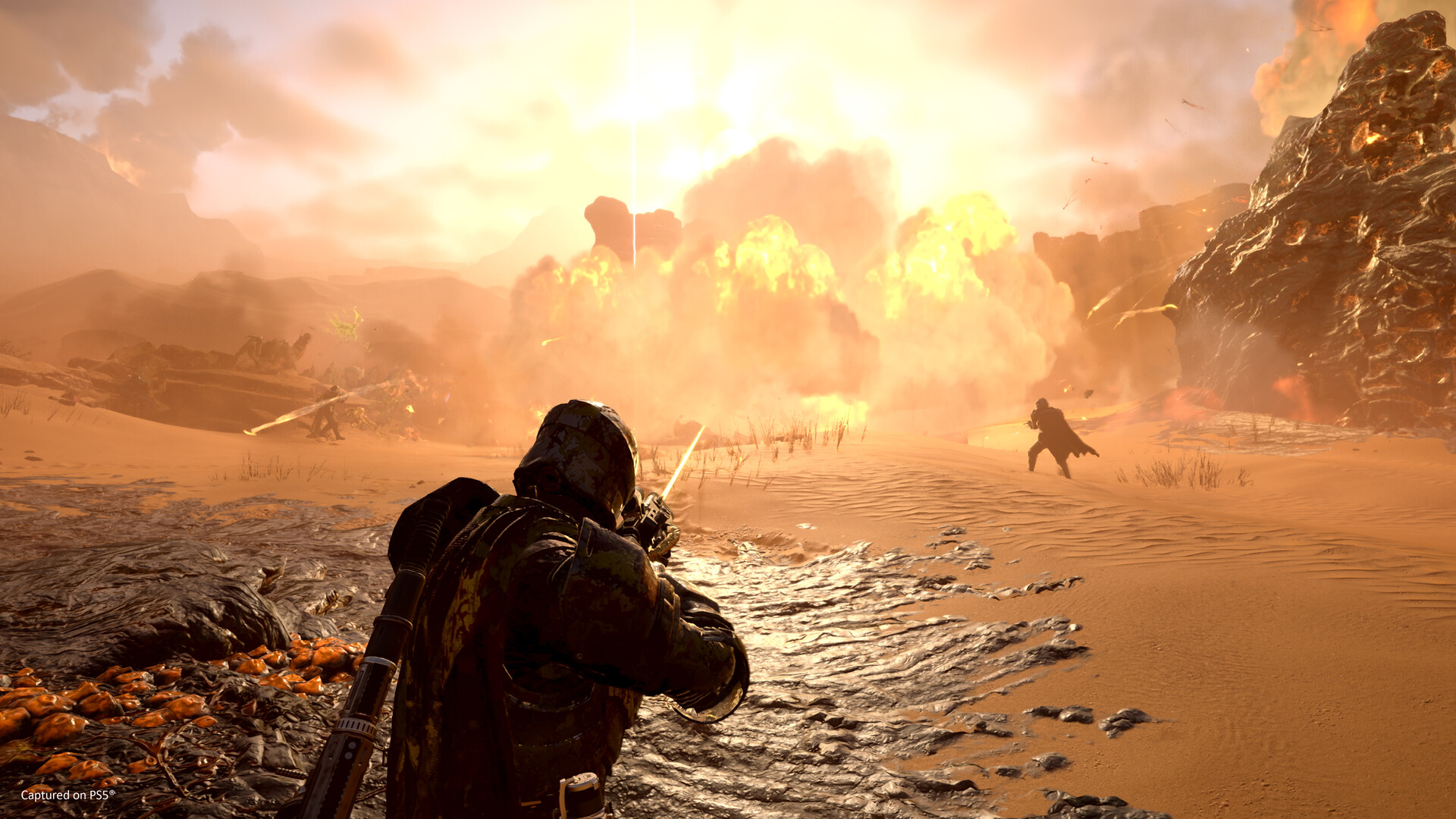 Combat encounter in Helldivers 2.
The faction problem
There are two enemy factions at launch — the insectoid Terminids and the robotic Automatons — and they play differently enough to require genuine loadout reconsideration. Terminids swarm in numbers, reward area-denial tools, and include heavily armoured variants that can shrug off most light weapons. Automatons shoot back with actual firearms, which means cover becomes relevant in a way it largely isn’t against bugs. Fighting them with a bug-optimised build feels like showing up to the wrong job.
The problem is that two factions, while meaningfully distinct, start showing their seams at higher difficulty levels. Enemy compositions are varied within each faction, but the mission structure — clear objectives, hold zones, destroy fabricators or egg clusters — repeats its verbs often enough that later missions begin feeling like remixes rather than escalations. It’s not fatal. The procedural map generation keeps layouts fresh, and the galactic war meta-campaign creates context that makes individual missions feel like contributions to something larger. But if you’re someone who needs structural novelty to stay engaged, the ceiling arrives faster than the hours logged might suggest.
The live-service question
Helldivers 2 launched with a battle pass structure — the Warbonds — that splits into a free tier and premium tiers priced at the game’s internal currency. The premium Warbonds contain weapons, armour, and cosmetic items. Crucially, the game’s premium currency can be found in small quantities during missions, which means a patient player can unlock paid content without spending additional money. It’s slower, but the option exists — and that matters when evaluating how aggressive the monetisation actually feels day-to-day.
The more interesting tension is between Arrowhead’s live updates and the game’s balance. Several weapons have cycled between useful and near-pointless across patches, sometimes within weeks of each other. The Railgun — a high-damage Stratagem weapon that became synonymous with the game’s early meta — was adjusted significantly after launch, and the community response was intense enough that it became a case study in how quickly live-service goodwill erodes. Arrowhead has been communicative about intent, which softens the sting, but the underlying problem is that a game built around specific power-fantasy loadouts needs to handle balance updates with more surgical care than a typical multiplayer shooter.
Performance and the platform situation
On PC, Helldivers 2 runs well on mid-range hardware — better than its launch state suggested it would, after several stability patches addressed the more egregious stuttering. The game uses a third-person camera with a loose lock-on system that sometimes fights you in cramped terrain, though it’s rarely punishing enough to cost missions on its own. The audio design deserves a specific mention: the distinction between Termind screeches and Automaton gunfire is clean enough that you can identify what’s hunting you before you see it, which feeds directly into the tension management the game relies on.
The PlayStation Network account requirement controversy — briefly mandatory for PC players before Arrowhead walked it back following significant player backlash — illustrated something important about how Helldivers 2 exists in the world. It’s a game with a genuinely enthusiastic community whose trust is fragile in the specific way live-service communities tend to be. The goodwill Arrowhead built through transparent communication is real. So is the awareness that it can be spent faster than it accumulates.
Who this is actually for
Helldivers 2 is at its best with a coordinated group who’ve agreed to stop being precious about dying. The friendly fire is on by default, Stratagems misfire into squadmates with equal-opportunity lethality, and there’s a particular kind of player — probably someone who loved Magicka’s chaos or enjoyed Deep Rock Galactic’s incidental comedy — for whom that’s the whole point. Solo play is technically possible but strips out the improvisational energy that makes the game’s rough edges feel intentional rather than just rough.
Playing with randoms sits somewhere between those two poles. Matchmaking works, the ping system is functional, and most strangers are competent enough not to derail a mission. But the emergent storytelling — the moments worth recounting afterward — happens in the gaps between communication, and those gaps are harder to generate with people you’ll never queue with again.
The game Arrowhead shipped is flawed in ways that matter: limited faction variety, a balance cadence that hasn’t always earned trust, and a structure that stops surprising you if you’re not bringing your own curiosity to it. None of that makes it a bad game. It makes it a specific game — one that rewards the right kind of player with something genuinely rare, which is the feeling that everything falling apart might still be salvageable, and that it’ll make a good story either way.
Editorial scoring
Reader Q&A
How long does it take to finish Helldivers 2 is at its best when everything goes wrong?
Main story runs around 85 hours depending on how thoroughly you explore. Completionists can spend 2-3× that.
Is Helldivers 2 is at its best when everything goes wrong good for newcomers to Co-op Shooter?
Yes — Helldivers 2 is at its best when everything goes wrong is a great entry point. The early hours teach the systems gradually and the difficulty curve is reasonable.
Which platform should I play Helldivers 2 is at its best when everything goes wrong on?
Steam Deck handles this title well — verified compatibility on most recent patches.
Was Helldivers 2 is at its best when everything goes wrong worth the launch-day price?
Released in 2024, and as of writing it holds up. Wait for a sale if you’re price-sensitive — major discounts arrive within 6 months.
Are there DLCs or expansions worth picking up?
The base game is complete; expansion DLC adds 10-15 hours of additional content if you want more.
What did Arrowhead Game Studios get right (and what could be better)?
Strongest: art direction, audio design, set-piece variety. Weakest: late-game balance and a few persistent quest-log bugs.